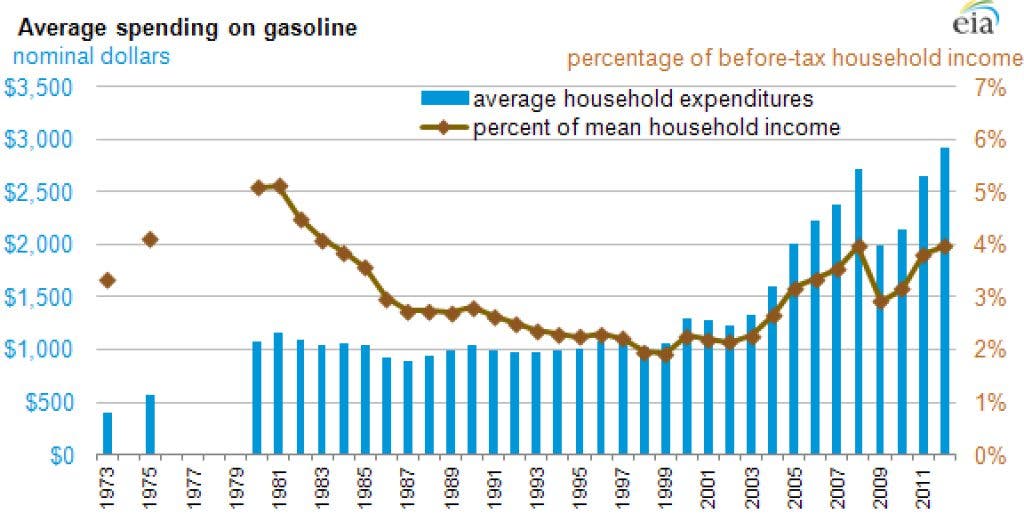
Families are devoting more of their money to gas these days than they have in most of the past 30 years, according to new estimates in a U.S. energy report.
The average American household spent $2,912—or about 4 percent of its gross income—on gas in 2012, according to estimates from the U.S. Energy Information Administration (EIA). This is a bigger drain on the family budget than at any time in the past three decades except 2008, when the gas grab was about the same.
What may be frustrating for some to hear is that while gas consumption has gone down in recent years, the budget burden has only gotten worse as gas prices have increased.
Back in the early 1980s, families were spending more than 5 percent of their income on gas but traveling much less than we do today. Since then, fuel efficiency has increased significantly, making it cost less per mile for us to get where we're going. However, while U.S. gas consumption was at its lowest level in 10 years in 2011, average gas prices increased that year by 26.1 percent and then again by 3.3 percent last year, according to the EIA.
---
How much is your family spending on gas? What do you do to save money? Tell us in the comments section.
If you buy an Electric Vehicle (EV) like the Nissan Leaf, your cost of electricity is MUCH cheaper than buying gas. How much cheaper? It works out to the equivalent of $0.36 per gallon... about a 90% SAVINGS over buying gas. Many places (including every Walgreens) offer FREE charging too! There's no sales tax on an EV, up to a $7500 federal tax CREDIT, and Nissan has dropped the price of the Made in America LEAF by $6000. If you haven't driven one before, go take a free test drive at our local area Nissan dealers. It's a comfortable, quick, fun car to drive as well. You most likely can qualify for a FREE 240V home charging system too. Where else in Shoreline can you charge up? Sears, Shoreline CC, all 3 Walgreens, and soon at City Hall. In October last year I drove 750 miles and my total 'bought' electricity was $10.48. How far can you drive for $10? Take the gas savings to pay for a brand new LEAF! Want to go farther? How about high speed fast chargers at Burlington Outlets on the way to Bellingham or Canada? Downtown, East Side, Fred Meyer Lake City has one, and all the way to California. New ones are being installed all the time. Oh, I forgot to mention: There's NO emissions either! With our hydro powered electricity, you could be driving the cleanest driving car in the world.
The economic vitality of the US over the past many decades is due in large part to the supply and demand efficiencies of our market economy. But an efficient market relies on the true costs of a product being reflected in its price. Subsidies alter this cost element, lessening the efficiency of the marketplace. Gasoline is heavily subsidized by the Federal government. The cost of building and maintaining our roads is also highly subsidized by a combination of State, Local and Federal taxes. Gasoline taxes cover less than 50% of the costs of building and maintaining our roads in Washington State. If we the people paid the true costs of driving in relation to how much demand we place on the resources, the up front cost to drive would be much higher than it is now.
There are 31.5 gallons per barrel of crude. My understanding is that oil companies need to get about $ 70 per barrel of crude or over $ 2.00 per gallon to justify the development of new oil fields today. Development has skyrocketed because of availability. Drilling a mile below the ocean floor is expensive. Crude needs to be refined and distributed before it is sold. Although climate change and possibly water contamination are of concern, the new process of fracking may free enough oil to satisfy U.S. demand for many years. Regardless, there certainly is enough natural gas to satisfy the American addiction to the automobile for decades. I would love to see the true burden of the cost of driving, particularlly the construction and maintenance of roads, be allocated to those who drive. The short to medium term burden to the poor is a challenge. In the long run it would probably be a benefit because of increased access associated with more public transport.
"Better to remain silent and be thought a fool than to speak and to remove all doubt." (nobody really knows who said this first, but it is usually attibuted to Abraham Lincoln).